
Phase Diagrams and Phase Transformations
Phase Diagrams: Phase diagrams are graphical representations that illustrate the relationships between different phases (such as solid, liquid, and gas) of a substance under varying conditions of temperature and pressure. They provide valuable insights into the boundaries and regions where specific phases are stable, helping to predict how materials will behave under different environmental conditions.
Phase Transformations: Phase transformations refer to the changes that occur in the structure and composition of a material as it transitions from one phase to another. These transformations are influenced by factors like temperature, pressure, and composition. Common phase transformations include melting, freezing, evaporation, condensation, and crystallization, which play a crucial role in understanding material behavior and applications.
Introduction to phase diagrams and their significance
Introduction to phase diagrams and their significance
Phase diagrams are fundamental tools in materials science and engineering, offering a visual representation of the relationships between different phases of a substance as it undergoes changes in temperature and pressure. These diagrams provide a comprehensive understanding of how materials transform from one phase to another, guiding the design, development, and optimization of various processes and products.
At their core, phase diagrams map out the conditions under which different phases, such as solids, liquids, and gases, are stable for a given material composition. By plotting temperature and pressure on the axes, these diagrams unveil the boundaries between phases and highlight regions where multiple phases coexist. This insight is pivotal in predicting the behavior of materials when subjected to specific environmental conditions, enabling engineers and scientists to tailor materials for diverse applications.
The significance of phase diagrams extends across various fields, from metallurgy and ceramics to pharmaceuticals and geology. Engineers can utilize phase diagrams to determine optimal manufacturing parameters, ensuring the production of high-quality materials with desired properties. Chemists leverage these diagrams to synthesize compounds and predict their behavior during chemical reactions. In the realm of geology, phase diagrams shed light on the formation and evolution of minerals in Earth's crust.
In essence, phase diagrams serve as roadmaps that unlock the secrets of material behavior. Their ability to elucidate the conditions under which phase transformations occur empowers researchers and practitioners to manipulate materials at the atomic and molecular level, leading to innovations in technology, industry, and scientific exploration. As a result, phase diagrams remain a cornerstone of materials science, fostering advancements that drive progress in countless areas of human endeavor.
Components, phases, and the Gibbs phase rule
Components, Phases, and the Gibbs Phase Rule
In the study of phase diagrams and materials behaviour, the concepts of components, phases, and the Gibbs Phase Rule play pivotal roles in understanding and predicting the relationships between different states of matter and their transformations.
Components: Components are the fundamental chemical constituents that make up a system. Each component can vary independently in composition, and the number of components determines the degree of compositional variability within the system. For instance, a binary system has two components, while a ternary system has three. The presence of different components influences the number and types of phases that can exist in each system.
Phases: Phases are distinct, homogeneous states of matter with uniform composition and distinct physical properties. They can include solid, liquid, and gas phases, each with unique characteristics. In a system, phases can coexist under certain conditions, and phase transitions occur when a substance changes from one phase to another due to changes in temperature and pressure. Understanding the stability and behavior of phases is essential for predicting the transformations that materials undergo.
Gibbs Phase Rule: The Gibbs Phase Rule, formulated by Josiah Willard Gibbs, is a fundamental equation that relates the number of degrees of freedom, phases, and components in a system. It helps determine the conditions under which a given system can exist in equilibrium. The rule is expressed as:
F = C - P + 2
Where:
F represents the degrees of freedom, which indicates the number of intensive variables (such as temperature and pressure) that can be varied independently without violating the phase equilibrium.
C is the number of components.
P is the number of phases present in the system.
The Gibbs Phase Rule helps elucidate the relationships between the key variables in a system and provides insights into the number of variables that can be manipulated while keeping the system at equilibrium. This rule is particularly useful for understanding the conditions where phase coexistence is possible and predicting the behaviour of complex systems with multiple phases and components.
A simple example involving a two-component system: water (H2O) and ethanol (C2H5OH), which can coexist in two phases: liquid and vapor. We'll assume the system is in a closed container.
In this example, we have:
Number of components (C) = 2 (water and ethanol)
Number of phases (P) = 2 (liquid and vapor)
Degrees of freedom (F) = ?
According to Gibbs' Law: F = C - P + 2
Plugging in the values: F = 2 - 2 + 2 F = 2
So, the system has 2 degrees of freedom. This means that we can independently vary two intensive variables, like temperature and pressure, while keeping the composition of the phases in equilibrium.
Let's say we choose temperature (T) and pressure (P) as our independent variables. We can manipulate these variables if they stay within the bounds dictated by the phase equilibria of water and ethanol. For instance, we can set a specific temperature and pressure and find the corresponding equilibrium compositions of liquid and vapor phases for water and ethanol in the closed container.
However, if we fix all three variables (temperature, pressure, and composition), the system will be fully determined and no phase changes can occur without changing one of these variables.
Binary and ternary phase diagrams
Binary and Ternary Phase Diagrams
Phase diagrams provide invaluable insights into the behaviour of materials as they transition between different phases under varying conditions of temperature and pressure. Binary and ternary phase diagrams are two key types of diagrams that offer a deeper understanding of how materials with multiple components behave during phase transformations.
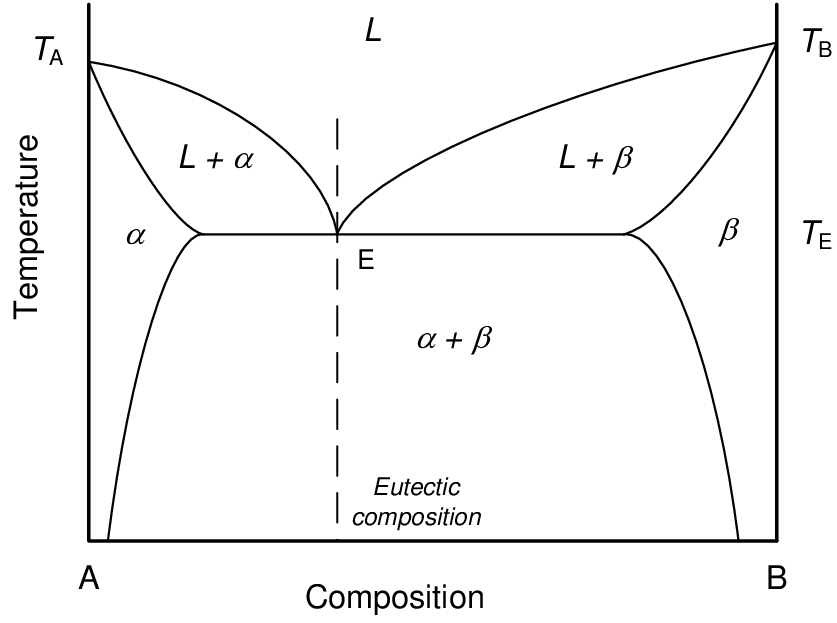
Binary Phase Diagrams: A binary phase diagram is a graphical representation that showcases the relationships between the phases of a material composed of two components. The components are typically plotted on the two axes, and the diagram illustrates the conditions at which different phases coexist and the boundaries between these phases. Commonly observed phase transitions in binary phase diagrams include melting (solid to liquid), solidification (liquid to solid), and vaporization (liquid to gas).
The binary phase diagram reveals important information such as the eutectic point (lowest melting point), eutectoid point (solid-to-solid transformation), and peritectic point (solid-liquid transformation). Understanding these critical points aids in designing alloys, optimizing materials for specific applications, and predicting the behavior of mixtures under different conditions.
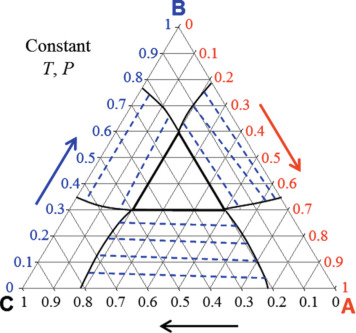
Ternary Phase Diagrams: Ternary phase diagrams extend the concept of binary phase diagrams to systems with three components. In these diagrams, the three components are typically represented by three vertices of a triangular graph. The phases that form within the ternary system are depicted within the triangular regions. Just like binary diagrams, ternary phase diagrams provide insights into the stability of different phases and the conditions at which phase transformations occur.
Ternary diagrams are especially useful in fields such as metallurgy, ceramics, and geology where complex mixtures of elements or compounds are encountered. They help researchers and engineers understand the behaviour of multi-component systems, predict the outcomes of alloying or blending different materials, and optimize processing conditions for desired properties.
Significance: Binary and ternary phase diagrams have significant practical implications across a range of industries. They guide the production of materials with specific properties by helping manufacturers select appropriate compositions and processing conditions. Engineers use these diagrams to avoid undesirable phase transformations during material processing and to design alloys with enhanced strength, corrosion resistance, and other desirable characteristics.
Solidification, melting, and phase transformations
Solidification, melting, and phase transformations:
Solidification: Transforming Liquids into Solids
Solidification, also known as freezing or crystallization, is a fundamental phase transformation process in which a liquid substance transitions into a solid state. This transformative phenomenon is integral to numerous natural processes, industrial applications, and the formation of various materials, from metals to ice.
Key Concepts in Solidification:
Nucleation: Solidification begins with the formation of tiny solid particles within the liquid, a process known as nucleation. Nuclei act as the initial building blocks for the growing solid structure.
Crystal Growth: Once nucleation occurs, these nuclei serve as templates for the growth of solid crystals. Atoms or molecules from the liquid attach themselves to the nuclei, leading to the expansion of solid regions.
Heat Removal: The driving force behind solidification is the removal of heat from the liquid, causing its temperature to decrease. As heat is extracted, the kinetic energy of particles decreases, allowing them to arrange into an ordered, closely packed structure characteristic of solids.
Phases and Microstructures:
During solidification, the solid phase gradually displaces the liquid phase as the dominant form of matter. The exact microstructure of the solid that forms depend on various factors, including the material's composition, cooling rate, and the presence of impurities. These factors influence the arrangement of atoms or molecules within the solid lattice, ultimately affecting the material's mechanical, thermal, and electrical properties.
Solidification Processes:
Eutectic Solidification: In a binary system with specific compositions, eutectic solidification occurs at a distinct temperature. At this point, both components solidify simultaneously, leading to a microstructure composed of alternating phases.
Dendritic Solidification: This process is common in metals and alloys. As crystals grow from nuclei, they form branching, tree-like structures called dendrites. The shape and spacing of dendrites influence the mechanical properties of the solid material.
Peritectic Solidification: In some systems, a liquid phase reacts with a solid phase to form a different solid phase. This process involves both solidification and chemical reactions.
Applications and Significance:
Solidification has broad applications across industries:
Metallurgy: The quality and properties of metallic materials, such as steel and aluminum, are greatly influenced by their solidification processes. Controlling solidification rates can lead to stronger and more durable products.
Casting: Manufacturing processes like casting involve the controlled solidification of molten materials into specific shapes and forms, ranging from engine parts to artistic sculptures.
Freezing and Crystallization: In fields like food processing and pharmaceuticals, controlled freezing and crystallization preserve products and enhance their quality.
Semiconductor Fabrication: The precise solidification of materials is crucial in semiconductor manufacturing, ensuring the creation of intricate electronic components.
Melting: The Transition from Solid to Liquid
Melting, also referred to as fusion, is the phase transition process through which a solid substance transforms into a liquid state. This essential phenomenon occurs across a wide range of materials and has significant implications in everyday life, industry, and scientific exploration.
Key Concepts in Melting:
Energy Absorption: To melt a solid, energy must be supplied to overcome the attractive forces that hold its particles together in a structured lattice. This energy, known as the heat of fusion, is absorbed by the solid as it undergoes the transition.
Disruption of Order: As heat is absorbed, the solid's particles gain enough energy to break free from their ordered arrangement, causing the solid structure to loosen and transition into a more disordered liquid state.
Melting Point: The temperature at which a substance changes from solid to liquid is known as its melting point. It is a characteristic property of each substance and remains constant under a specific pressure.
Phases and Transformation:
The process of melting involves the transition from the solid phase to the liquid phase. During this transition, the internal energy of the material increases as the particles gain kinetic energy and move more freely. The arrangement of molecules or atoms shifts from a regular lattice in the solid phase to a less ordered arrangement in the liquid phase.
Applications and Significance:
Manufacturing and Industry: In metallurgy, metals are often melted to be cast into various shapes, forming components for machinery, vehicles, and infrastructure. The precise control of melting processes is crucial for achieving desired properties in the final products.
Materials Science: Understanding melting behavior is essential for developing new materials with specific properties. This knowledge guides the creation of materials used in electronics, construction, and various other applications.
Energy: Melting is a key process in energy-related applications, such as fusion reactors where extreme heat is used to induce fusion of atomic nuclei to generate energy.
Cooking and Food Processing: In the culinary world, melting is a crucial step in various recipes. Ingredients like butter, chocolate, and sugar undergo melting to create delectable dishes and treats.
Climate and Geology: The melting of glaciers and ice caps contributes to sea level rise, while the study of melting processes in rocks and minerals aids geologists in understanding Earth's history and geological events.