
Element FolioElement FolioAdvanced Materials IntelligencePSEMIC ERP ↗
MODULE 03

Materials Processing

5 subjects · structured reading from the supplied course material

SUBJECT 01 / 05

Phase Diagrams and Phase Transformations

Phase Diagrams: Phase diagrams are graphical representations that illustrate the relationships between different phases (such as solid, liquid, and gas) of a substance under varying conditions of temperature and pressure. They provide valuable insights into the boundaries and regions where specific phases are stable, helping to predict how materials will behave under different environmental conditions.

Phase Transformations: Phase transformations refer to the changes that occur in the structure and composition of a material as it transitions from one phase to another. These transformations are influenced by factors like temperature, pressure, and composition. Common phase transformations include melting, freezing, evaporation, condensation, and crystallization, which play a crucial role in understanding material behavior and applications.

TOPIC

Introduction to phase diagrams and their significance

Introduction to phase diagrams and their significance

Phase diagrams are fundamental tools in materials science and engineering, offering a visual representation of the relationships between different phases of a substance as it undergoes changes in temperature and pressure. These diagrams provide a comprehensive understanding of how materials transform from one phase to another, guiding the design, development, and optimization of various processes and products.

At their core, phase diagrams map out the conditions under which different phases, such as solids, liquids, and gases, are stable for a given material composition. By plotting temperature and pressure on the axes, these diagrams unveil the boundaries between phases and highlight regions where multiple phases coexist. This insight is pivotal in predicting the behavior of materials when subjected to specific environmental conditions, enabling engineers and scientists to tailor materials for diverse applications.

The significance of phase diagrams extends across various fields, from metallurgy and ceramics to pharmaceuticals and geology. Engineers can utilize phase diagrams to determine optimal manufacturing parameters, ensuring the production of high-quality materials with desired properties. Chemists leverage these diagrams to synthesize compounds and predict their behavior during chemical reactions. In the realm of geology, phase diagrams shed light on the formation and evolution of minerals in Earth's crust.

In essence, phase diagrams serve as roadmaps that unlock the secrets of material behavior. Their ability to elucidate the conditions under which phase transformations occur empowers researchers and practitioners to manipulate materials at the atomic and molecular level, leading to innovations in technology, industry, and scientific exploration. As a result, phase diagrams remain a cornerstone of materials science, fostering advancements that drive progress in countless areas of human endeavor.

TOPIC

Components, phases, and the Gibbs phase rule

Components, Phases, and the Gibbs Phase Rule

In the study of phase diagrams and materials behaviour, the concepts of components, phases, and the Gibbs Phase Rule play pivotal roles in understanding and predicting the relationships between different states of matter and their transformations.

Components: Components are the fundamental chemical constituents that make up a system. Each component can vary independently in composition, and the number of components determines the degree of compositional variability within the system. For instance, a binary system has two components, while a ternary system has three. The presence of different components influences the number and types of phases that can exist in each system.

Phases: Phases are distinct, homogeneous states of matter with uniform composition and distinct physical properties. They can include solid, liquid, and gas phases, each with unique characteristics. In a system, phases can coexist under certain conditions, and phase transitions occur when a substance changes from one phase to another due to changes in temperature and pressure. Understanding the stability and behavior of phases is essential for predicting the transformations that materials undergo.

Gibbs Phase Rule: The Gibbs Phase Rule, formulated by Josiah Willard Gibbs, is a fundamental equation that relates the number of degrees of freedom, phases, and components in a system. It helps determine the conditions under which a given system can exist in equilibrium. The rule is expressed as:

F = C - P + 2

Where:

F represents the degrees of freedom, which indicates the number of intensive variables (such as temperature and pressure) that can be varied independently without violating the phase equilibrium.

C is the number of components.

P is the number of phases present in the system.

The Gibbs Phase Rule helps elucidate the relationships between the key variables in a system and provides insights into the number of variables that can be manipulated while keeping the system at equilibrium. This rule is particularly useful for understanding the conditions where phase coexistence is possible and predicting the behaviour of complex systems with multiple phases and components.

A simple example involving a two-component system: water (H2O) and ethanol (C2H5OH), which can coexist in two phases: liquid and vapor. We'll assume the system is in a closed container.

In this example, we have:

Number of components (C) = 2 (water and ethanol)

Number of phases (P) = 2 (liquid and vapor)

Degrees of freedom (F) = ?

According to Gibbs' Law: F = C - P + 2

Plugging in the values: F = 2 - 2 + 2 F = 2

So, the system has 2 degrees of freedom. This means that we can independently vary two intensive variables, like temperature and pressure, while keeping the composition of the phases in equilibrium.

Let's say we choose temperature (T) and pressure (P) as our independent variables. We can manipulate these variables if they stay within the bounds dictated by the phase equilibria of water and ethanol. For instance, we can set a specific temperature and pressure and find the corresponding equilibrium compositions of liquid and vapor phases for water and ethanol in the closed container.

However, if we fix all three variables (temperature, pressure, and composition), the system will be fully determined and no phase changes can occur without changing one of these variables.

TOPIC

Binary and ternary phase diagrams

Binary and Ternary Phase Diagrams

Phase diagrams provide invaluable insights into the behaviour of materials as they transition between different phases under varying conditions of temperature and pressure. Binary and ternary phase diagrams are two key types of diagrams that offer a deeper understanding of how materials with multiple components behave during phase transformations.
Course illustration

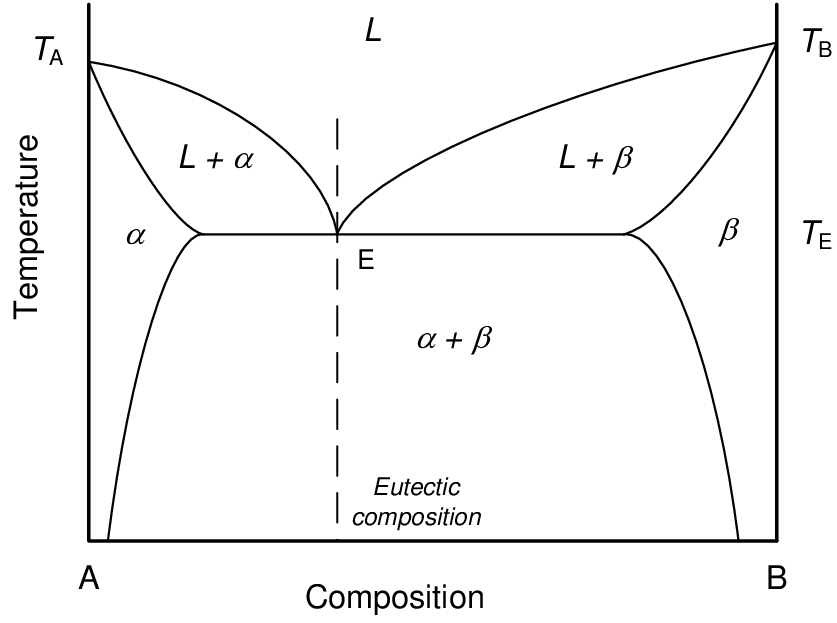
Binary Phase Diagrams: A binary phase diagram is a graphical representation that showcases the relationships between the phases of a material composed of two components. The components are typically plotted on the two axes, and the diagram illustrates the conditions at which different phases coexist and the boundaries between these phases. Commonly observed phase transitions in binary phase diagrams include melting (solid to liquid), solidification (liquid to solid), and vaporization (liquid to gas).

The binary phase diagram reveals important information such as the eutectic point (lowest melting point), eutectoid point (solid-to-solid transformation), and peritectic point (solid-liquid transformation). Understanding these critical points aids in designing alloys, optimizing materials for specific applications, and predicting the behavior of mixtures under different conditions.
Course illustration

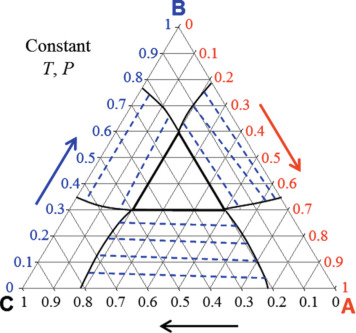
Ternary Phase Diagrams: Ternary phase diagrams extend the concept of binary phase diagrams to systems with three components. In these diagrams, the three components are typically represented by three vertices of a triangular graph. The phases that form within the ternary system are depicted within the triangular regions. Just like binary diagrams, ternary phase diagrams provide insights into the stability of different phases and the conditions at which phase transformations occur.

Ternary diagrams are especially useful in fields such as metallurgy, ceramics, and geology where complex mixtures of elements or compounds are encountered. They help researchers and engineers understand the behaviour of multi-component systems, predict the outcomes of alloying or blending different materials, and optimize processing conditions for desired properties.

Significance: Binary and ternary phase diagrams have significant practical implications across a range of industries. They guide the production of materials with specific properties by helping manufacturers select appropriate compositions and processing conditions. Engineers use these diagrams to avoid undesirable phase transformations during material processing and to design alloys with enhanced strength, corrosion resistance, and other desirable characteristics.

TOPIC

Solidification, melting, and phase transformations

Solidification, melting, and phase transformations:

Solidification: Transforming Liquids into Solids

Solidification, also known as freezing or crystallization, is a fundamental phase transformation process in which a liquid substance transitions into a solid state. This transformative phenomenon is integral to numerous natural processes, industrial applications, and the formation of various materials, from metals to ice.

Key Concepts in Solidification:

Nucleation: Solidification begins with the formation of tiny solid particles within the liquid, a process known as nucleation. Nuclei act as the initial building blocks for the growing solid structure.

Crystal Growth: Once nucleation occurs, these nuclei serve as templates for the growth of solid crystals. Atoms or molecules from the liquid attach themselves to the nuclei, leading to the expansion of solid regions.

Heat Removal: The driving force behind solidification is the removal of heat from the liquid, causing its temperature to decrease. As heat is extracted, the kinetic energy of particles decreases, allowing them to arrange into an ordered, closely packed structure characteristic of solids.

Phases and Microstructures:

During solidification, the solid phase gradually displaces the liquid phase as the dominant form of matter. The exact microstructure of the solid that forms depend on various factors, including the material's composition, cooling rate, and the presence of impurities. These factors influence the arrangement of atoms or molecules within the solid lattice, ultimately affecting the material's mechanical, thermal, and electrical properties.

Solidification Processes:

Eutectic Solidification: In a binary system with specific compositions, eutectic solidification occurs at a distinct temperature. At this point, both components solidify simultaneously, leading to a microstructure composed of alternating phases.

Dendritic Solidification: This process is common in metals and alloys. As crystals grow from nuclei, they form branching, tree-like structures called dendrites. The shape and spacing of dendrites influence the mechanical properties of the solid material.

Peritectic Solidification: In some systems, a liquid phase reacts with a solid phase to form a different solid phase. This process involves both solidification and chemical reactions.

Applications and Significance:

Solidification has broad applications across industries:

Metallurgy: The quality and properties of metallic materials, such as steel and aluminum, are greatly influenced by their solidification processes. Controlling solidification rates can lead to stronger and more durable products.

Casting: Manufacturing processes like casting involve the controlled solidification of molten materials into specific shapes and forms, ranging from engine parts to artistic sculptures.

Freezing and Crystallization: In fields like food processing and pharmaceuticals, controlled freezing and crystallization preserve products and enhance their quality.

Semiconductor Fabrication: The precise solidification of materials is crucial in semiconductor manufacturing, ensuring the creation of intricate electronic components.

Melting: The Transition from Solid to Liquid

Melting, also referred to as fusion, is the phase transition process through which a solid substance transforms into a liquid state. This essential phenomenon occurs across a wide range of materials and has significant implications in everyday life, industry, and scientific exploration.

Key Concepts in Melting:

Energy Absorption: To melt a solid, energy must be supplied to overcome the attractive forces that hold its particles together in a structured lattice. This energy, known as the heat of fusion, is absorbed by the solid as it undergoes the transition.

Disruption of Order: As heat is absorbed, the solid's particles gain enough energy to break free from their ordered arrangement, causing the solid structure to loosen and transition into a more disordered liquid state.

Melting Point: The temperature at which a substance changes from solid to liquid is known as its melting point. It is a characteristic property of each substance and remains constant under a specific pressure.

Phases and Transformation:

The process of melting involves the transition from the solid phase to the liquid phase. During this transition, the internal energy of the material increases as the particles gain kinetic energy and move more freely. The arrangement of molecules or atoms shifts from a regular lattice in the solid phase to a less ordered arrangement in the liquid phase.

Applications and Significance:

Manufacturing and Industry: In metallurgy, metals are often melted to be cast into various shapes, forming components for machinery, vehicles, and infrastructure. The precise control of melting processes is crucial for achieving desired properties in the final products.

Materials Science: Understanding melting behavior is essential for developing new materials with specific properties. This knowledge guides the creation of materials used in electronics, construction, and various other applications.

Energy: Melting is a key process in energy-related applications, such as fusion reactors where extreme heat is used to induce fusion of atomic nuclei to generate energy.

Cooking and Food Processing: In the culinary world, melting is a crucial step in various recipes. Ingredients like butter, chocolate, and sugar undergo melting to create delectable dishes and treats.

Climate and Geology: The melting of glaciers and ice caps contributes to sea level rise, while the study of melting processes in rocks and minerals aids geologists in understanding Earth's history and geological events.

Subject 1 of 5
SUBJECT 02 / 05

Heat Treatment of Materials

Heat treatment of materials refers to a controlled process in metallurgy and materials science where a material, typically a metal or alloy, is heated and cooled under specific conditions to alter its properties. This process is aimed at achieving desired characteristics such as improved hardness, strength, toughness, or other mechanical and physical properties. Heat treatment can involve various techniques like annealing, quenching, tempering, and aging, each designed to manipulate the microstructure of the material at the atomic level, resulting in tailored properties for specific applications.

TOPIC

Annealing, normalizing, quenching, and tempering

Annealing, normalizing, quenching, and tempering

Annealing is a heat treatment process used to modify the microstructure of a material, typically a metal or alloy, by heating it to a specific temperature and then slowly cooling it. The primary goal of annealing is to relieve internal stresses, improve ductility, enhance machinability, and refine the material's grain structure, thereby achieving desired mechanical and physical properties.

Here are the key aspects and steps involved in the annealing process:

Heating: The material is heated to a predetermined temperature, which is often above its critical temperature or recrystallization temperature. This temperature varies depending on the material's composition and desired outcome. The heating rate should be controlled to prevent thermal shock and ensure uniform heating.

Soaking: Once the material reaches the desired temperature, it is held at that temperature for a certain period. This soaking time allows for the homogenization of the material's internal structure and helps in achieving a uniform temperature throughout.

Cooling: After the soaking period, the material is slowly cooled down. The cooling rate is usually much slower than the heating rate and can significantly impact the resulting microstructure. Slow cooling helps prevent the formation of stress and distortion.

Types of Annealing:

Full Annealing: Involves heating the material to a temperature above its critical temperature, followed by slow cooling. It reduces hardness and increases ductility and toughness. Suitable for improving machinability and removing internal stresses.

Process Annealing: Used to recover ductility and reduce hardness in cold-worked materials without significantly altering their mechanical properties. The material is heated below its critical temperature and then slowly cooled.

Isothermal Annealing: The material is held at a constant temperature for an extended period, allowing equilibrium to be reached within the microstructure. This results in a uniform grain structure.

Homogenization Annealing: Used to eliminate compositional variations in alloys. The material is heated to a temperature where solid-state diffusion can occur, leading to a more uniform composition.

Stress Relief Annealing: Intended to reduce residual stresses within a material without altering its microstructure. The material is heated to a temperature below its critical point and then slowly cooled.

Normalizing: is a heat treatment process used to refine the grain structure and improve the mechanical properties of metals and alloys. It involves heating the material to a specific temperature above its critical point and then allowing it to cool in still air. Normalizing is particularly effective in achieving uniformity in the microstructure and relieving internal stresses caused by uneven cooling or previous processing.

Here are the key steps and characteristics of the normalizing process:

Heating: The material is heated to a temperature slightly above its upper critical temperature. This temperature is typically lower than that used in full annealing. Heating at this temperature facilitates the formation of a homogenous and fine-grained microstructure.

Soaking: The material is held at the elevated temperature for a predetermined period, allowing the microstructure to fully equilibrate. This ensures that the material undergoes a uniform transformation across its entire volume.

Cooling: After the soaking period, the material is removed from the furnace and allowed to cool in still air. Unlike annealing, where slow cooling is used, normalizing involves air cooling. This rapid cooling rate encourages the formation of a fine grain structure.

Effects of Normalizing:

Grain Refinement: The cooling process during normalizing leads to the formation of finer grains compared to the initial microstructure. This finer grain structure often results in improved mechanical properties such as increased strength and hardness.

Reduced Internal Stresses: Normalizing helps relieve internal stresses that might have developed due to uneven cooling or prior manufacturing processes.

Uniformity: The combination of heating and controlled cooling results in a uniform microstructure throughout the material, enhancing its overall consistency.

Application:

Normalizing is commonly applied to carbon and low-alloy steels to refine their grain structure, enhance mechanical properties, and improve machinability.

It is often used before further processing steps, such as machining, forging, or additional heat treatments, to ensure that the material's properties are consistent and favorable for these processes.

Normalizing is especially effective for materials that require improved strength and toughness while maintaining good machinability. The process provides a balance between grain refinement and mechanical property enhancement without the need for complex cooling techniques. By carefully controlling the normalizing parameters, materials engineers can achieve desired microstructural changes and tailor the material's properties to meet specific application requirements.

Quenching: is a heat treatment process used to rapidly cool a material, typically a metal or alloy, from a high temperature to achieve specific properties and desired microstructures. This rapid cooling is often achieved by immersing the hot material into a quenching medium, such as water, oil, or air, depending on the material's composition and the desired outcome.

Here are the key features and steps of the quenching process:

Heating: The material is heated to a temperature above its critical point or transformation temperature. This is the temperature at which certain structural changes occur within the material's microstructure, allowing for the development of desired properties upon quenching.

Transformation: As the material is heated, it undergoes phase transformations, such as austenitization in steel, where the material's microstructure changes to a more homogenous and uniform phase.

Quenching: The heated material is rapidly cooled by immersing it into a quenching medium. The choice of quenching medium depends on the material's composition and desired results. Water, oil, and air are common quenching media.

Cooling Rate: The rapid cooling rate during quenching "freezes" the microstructure, preventing the material from undergoing certain phase changes. This often leads to the formation of hard and brittle structures.

Effects of Quenching:

Hardness: Quenching can significantly increase the hardness of the material due to the rapid cooling rate. This is particularly evident in steel, where it results in the formation of martensite, a very hard and brittle phase.

Strength: Quenching can improve the strength of materials, making them more suitable for applications where high load-bearing capacity is essential.

Brittleness: While quenching enhances hardness and strength, it can also make the material more brittle. This brittleness can be mitigated by subsequent tempering.

Tempering: In many cases, materials that have been quenched are subsequently tempered. Tempering involves reheating the material to a lower temperature and then cooling it. This process helps reduce brittleness and improve toughness while retaining a desirable level of hardness and strength.

Application:

Quenching is commonly used in the production of steel and other alloys to achieve a combination of hardness and strength required for various industrial applications, such as tools, gears, and mechanical components.

It is also used in the heat treatment of non-ferrous metals, polymers, and ceramics to achieve specific material properties.

Quenching is a critical step in heat treatment processes, allowing materials engineers to manipulate a material's microstructure and properties for specific applications. Careful control of the quenching process, including cooling rate and quenching medium, is essential to achieve the desired balance between hardness, strength, and ductility.

Tempering: is a heat treatment process used to improve the mechanical properties of materials, particularly metals and alloys, that have been previously hardened through processes like quenching. Tempering involves reheating the hardened material to a specific temperature and then allowing it to cool in a controlled manner. The primary purpose of tempering is to reduce brittleness, increase toughness, and relieve internal stresses, while retaining a desirable level of hardness and strength.

Here are the key steps and characteristics of the tempering process:

Hardening Stage: Before tempering, the material is usually subjected to a hardening process such as quenching. Quenching rapidly cools the material to transform its microstructure and enhance its hardness.

Heating: The hardened material is reheated to a temperature below its critical point, which is usually lower than the temperature used for the original hardening process (quenching). The specific tempering temperature depends on the material and the desired properties.

Soaking: The material is held at the tempering temperature for a specified period to allow for the diffusion of atoms within the microstructure. This helps to relieve internal stresses and facilitate the desired structural changes.

Cooling: After the soaking period, the material is allowed to cool either in still air or at a controlled rate. The cooling rate during tempering is generally slower than during hardening or quenching.

Effects of Tempering:

Toughness: One of the main benefits of tempering is the increase in toughness or resistance to fracture. The controlled reheating and slower cooling allow for the formation of finer microstructures, which can absorb more energy before failing.

Reduction in Hardness: While tempering results in a reduction in hardness compared to the initial hardened state, it still maintains a suitable level of hardness for specific applications.

Stress Relief: Tempering helps to relieve internal stresses that might have been introduced during the quenching process. This can reduce the risk of distortion or cracking.

Ductility: Tempering improves the material's ductility, making it less brittle and more suitable for applications where some deformation without fracture is desired.

Application:

Tempering is commonly used in conjunction with hardening processes like quenching. It is particularly important for steels, where the initial quenching process leads to high hardness and brittleness.

Applications for tempered materials include components that require a balance of hardness, strength, toughness, and ductility, such as automotive parts, cutting tools, and machinery components.

Tempering is a critical step in achieving the desired combination of properties in heat-treated materials. It allows materials engineers to fine-tune the balance between hardness and toughness, ensuring that the material is suited to its intended application and can withstand the mechanical and thermal stresses it may encounter.

TOPIC

Martensitic transformation and hardening mechanisms

Martensitic Transformation and Hardening Mechanisms:

Martensitic Transformation: The martensitic transformation is a phase transformation that occurs in certain types of materials, particularly in steels, when they undergo rapid cooling (quenching) from a high temperature. This transformation leads to the formation of a specific microstructure known as martensite. Martensite is characterized by its high hardness, strength, and brittleness. Unlike other phase transformations, the martensitic transformation is diffusion less, meaning that it occurs without the diffusion of atoms.

Hardening Mechanisms: The hardening of materials through the martensitic transformation involves specific mechanisms that contribute to the development of the characteristic properties of martensite:

Austenite-to-Martensite Transformation: In steels, the martensitic transformation typically starts from the parent phase known as austenite, which has a face-centered cubic (FCC) crystal structure. During rapid cooling (quenching), the atoms within the austenite structure rearrange themselves to form a new crystal structure with a lower symmetry known as martensite. This transformation occurs without atomic diffusion and leads to a distinctive needle-like or lath-like microstructure.

Shear Transformation: The martensitic transformation involves shear deformation of the crystal lattice, which leads to the formation of the martensitic microstructure. The atoms move relative to each other along specific crystallographic planes and directions. This shear transformation contributes to the distortion of the crystal lattice and the creation of the martensitic microstructure.

Supersaturation and High Internal Stresses: The rapid cooling during quenching results in a supersaturated solid solution of carbon and other alloying elements within the martensite. This supersaturation contributes to the increased hardness of martensite. Additionally, the shear transformation introduces high internal stresses, which contribute to the brittleness of the martensitic structure.

Key Characteristics of Martensite:

High hardness: Martensite is significantly harder than the original austenitic structure due to the lattice distortion and carbon supersaturation.

High strength: The shear transformation and internal stresses result in improved strength properties.

Brittleness: Martensite is brittle due to the lattice distortion and the high internal stresses. It can fracture with minimal deformation.

Lack of ductility: The lack of diffusion during the martensitic transformation restricts the ability of the material to deform plastically before fracturing.

Low toughness: Martensite's combination of brittleness and lack of ductility leads to low toughness, making it susceptible to cracking and failure under impact or sudden loads.

In engineering applications, the martensitic transformation is often utilized to achieve specific material properties, such as high hardness and wear resistance. However, due to the inherent brittleness of martensite, tempering is commonly performed to reduce brittleness and improve toughness while maintaining a desirable level of hardness and strength. This combination of quenching to form martensite and subsequent tempering is a common heat treatment sequence to achieve a balanced set of mechanical properties in steel components.

TOPIC

Precipitation hardening and age-hardening

Precipitation Hardening and Age Hardening:

Precipitation Hardening: Precipitation hardening, also known as age hardening or particle hardening, is a heat treatment process used to enhance the strength and hardness of certain alloys, primarily non-ferrous metals like aluminum, magnesium, and some types of stainless steel. This process involves a sequence of steps that enable the formation and growth of fine precipitate particles within the microstructure of the material. These precipitates hinder the movement of dislocations, resulting in increased strength while retaining a reasonable level of toughness.

Age Hardening Process: The age hardening process typically consists of the following stages:

Solution Treatment (Solutionizing): The alloy is heated to a high temperature (solutionizing temperature) to dissolve the alloying elements and form a homogeneous solid solution. This stage helps to put the alloying elements in a supersaturated state within the lattice.

Quenching: After solutionizing, the alloy is rapidly cooled (quenched) to room temperature. This prevents the formation of large precipitates and instead traps the alloying elements in a supersaturated solid solution.

Aging (Precipitation): The alloy is aged at a lower temperature. During this stage, the supersaturated solid solution becomes less stable, leading to the nucleation and growth of fine precipitate particles within the material's microstructure.

Hardening: The precipitate particles hinder the movement of dislocations, effectively increasing the strength of the material. The material becomes harder and stronger, but there may be some reduction in ductility.

Overaging: If the aging process is prolonged, the precipitate particles can grow too large, leading to a decrease in strength and hardness. This phenomenon is known as overaging. The goal is to achieve the optimal balance between hardness and toughness during the aging process.

Key Characteristics of Precipitation Hardening:

Precipitation hardening can significantly increase the strength and hardness of materials, making them suitable for applications requiring high mechanical performance.

The process allows for a degree of control over the properties of the material by adjusting the aging temperature and time.

Precipitation hardening can enhance resistance to wear, fatigue, and corrosion.

The presence of fine precipitate particles can also improve creep resistance at elevated temperatures.

There may be a trade-off between strength and ductility, as some ductility is sacrificed to achieve higher hardness and strength.

Applications:

Precipitation-hardened materials are widely used in aerospace, automotive, and other industries where high-strength components are required.

Aircraft components, such as structural parts and turbine blades, often utilize precipitation hardening to achieve the necessary combination of strength and weight savings.

Sporting goods, medical devices, and various industrial equipment can also benefit from precipitation-hardened materials.

TOPIC

Case hardening and surface treatments

Case Hardening and Surface Treatments:

Case Hardening: Case hardening, also known as surface hardening, is a heat treatment process used to enhance the hardness and wear resistance of the outer layer (case) of a material, typically steel or iron. The objective of case hardening is to create a hard and wear-resistant surface layer while maintaining a tougher and more ductile core. This is particularly useful in applications where a combination of hardness and toughness is required.

Types of Case Hardening:

Carburizing: In carburizing, the material is heated in a carbon-rich environment at elevated temperatures. Carbon atoms diffuse into the material's surface, forming a high-carbon layer. After carburizing, the material is quenched to harden the surface, followed by tempering to achieve the desired balance of hardness and toughness.

Nitriding: Nitriding involves introducing nitrogen into the surface of the material by exposing it to a nitrogen-rich atmosphere at elevated temperatures. Nitrogen forms nitrides with certain alloying elements, resulting in a hard surface layer. Nitriding is known for improving wear and corrosion resistance.

Carbonitriding: Carbonitriding is a combination of carburizing and nitriding, where both carbon and nitrogen are introduced into the surface of the material. This process aims to achieve both hardness and improved wear resistance.

Flame Hardening: Flame hardening involves heating the surface of the material using a high-temperature flame and then rapidly quenching it. This process is suitable for selective hardening of specific areas.

Surface Treatments:

Surface treatments are processes that modify the surface properties of a material without significantly altering its bulk properties. These treatments are applied to enhance attributes like corrosion resistance, wear resistance, and appearance. Common surface treatments include:

Plating: Plating involves depositing a thin layer of a different metal onto the surface of a substrate. This can improve corrosion resistance, aesthetics, and even electrical conductivity.

Coating: Coatings can include paints, polymers, ceramics, and other materials applied to the surface. They protect against corrosion, wear, and environmental factors.

Anodizing: Anodizing is commonly applied to aluminum. It involves creating an oxide layer on the surface through an electrolytic process. Anodized surfaces are harder, more corrosion-resistant, and can be dyed for color.

Passivation: Passivation is used to enhance the corrosion resistance of stainless steels. It involves removing iron contaminants from the surface, allowing the formation of a protective passive oxide layer.

Shot Peening: Shot peening involves bombarding the surface of a material with small spherical particles to induce compressive stresses. This improves fatigue resistance and enhances the material's mechanical properties.

Applications:

Case hardening is used in gears, bearings, shafts, and other components subjected to wear and fatigue.

Surface treatments are applied to various components in industries like automotive, aerospace, electronics, and consumer goods.

These processes extend the service life of components, reduce maintenance, and improve overall performance.

Subject 2 of 5
SUBJECT 03 / 05

Mechanical Processing of Materials: Casting, Forming, and Machining

Mechanical processing of materials refers to a set of manufacturing techniques that involve altering the shape, structure, or properties of materials using mechanical forces, such as deformation, cutting, grinding, and machining. These processes are used to create desired shapes, sizes, and surface finishes, and to improve mechanical properties like strength, hardness, and toughness. Mechanical processing methods are essential in industries like manufacturing, construction, and engineering, where raw materials are transformed into finished products through various mechanical operations.

Certainly! Bulk deformation processes, including rolling, forging, and extrusion, are methods used to shape large quantities of metal into desired forms through plastic deformation. These processes are widely used in industries such as manufacturing, construction, and transportation to create various components with specific mechanical properties.

Casting processes

Casting processes, including sand casting, investment casting, and die casting, are methods used to create metal components by pouring molten metal into a mold, allowing it to solidify, and then removing the mold to reveal the finished part. These processes are widely used in industries such as automotive, aerospace, and manufacturing to produce a variety of metal parts with different sizes, shapes, and complexities.

An overview of these casting processes:

Sand Casting: Sand casting is a process where a mold made of sand is used to create a metal part. The mold is created by compacting a special sand mixture around a pattern that's the shape of the desired part. Once the mold is prepared, molten metal is poured into the mold cavity, and after it cools and solidifies, the mold is removed to reveal the cast part. Sand casting is versatile and can be used for producing both simple and complex parts.

Investment Casting (Lost-Wax Casting): Investment casting is a precision casting process used to create intricate and highly detailed parts. It involves creating a wax or wax-like pattern of the part, coating the pattern with a ceramic material to create a mold, and then melting out the wax to leave a cavity. Molten metal is then poured into the cavity, and after solidification, the mold is broken to retrieve the finished part. Investment casting is often used for creating jewelry, aerospace components, and medical devices.

Die Casting: Die casting is a process used to produce metal parts with high dimensional accuracy and smooth surface finishes. It involves forcing molten metal into a reusable metal mold, called a die, under high pressure. The mold has the shape of the desired part, and once the metal cools and solidifies, the mold is opened to reveal the finished part. Die casting is used for creating components with complex shapes and thin walls, such as automotive parts and electronic enclosures.

Key Characteristics:

TOPIC

Casting processes: sand casting, investment casting, die casting

Casting processes involve pouring molten metal into a mold to create solidified parts.

These processes allow for the production of parts with varying levels of complexity and sizes.

Material selection, mold design, and process parameters impact the quality of the cast parts.

Applications:

Sand casting is used for producing large and small components in industries like automotive and construction.

Investment casting is ideal for creating intricate and delicate parts in industries like aerospace and jewelry.

Die casting is commonly used for producing high-quality parts with fine details and complex shapes in industries such as automotive and electronics.

Casting processes are essential for producing a wide range of metal components, from simple to intricate, and offer versatile solutions for different industries requiring parts with specific properties and shapes.

TOPIC

Bulk deformation processes: rolling, forging, extrusion

Bulk Deformation Processes:

Rolling: Rolling is a process that involves passing a metal material between a pair of rotating rolls to reduce its thickness or change its cross-sectional shape. The primary goal is to achieve uniform thickness and improved mechanical properties. There are several types of rolling processes, such as hot rolling and cold rolling, depending on the temperature at which the rolling takes place.

Hot Rolling: In hot rolling, the metal is heated to a high temperature to make it more malleable. This process is used to produce sheets, plates, and structural shapes.

Cold Rolling: Cold rolling is done at room temperature, improving the material's surface finish and dimensional accuracy. It's commonly used for producing thin sheets and foils.

Forging: Forging involves shaping metal by applying compressive forces through the use of dies and tools. The process aims to improve the material's mechanical properties by aligning its grain structure and enhancing its strength. There are different types of forging processes:

Open Die Forging: In open die forging, the metal is placed between flat dies, and compressive forces are applied. This process is used for large and simple shapes.

Closed Die Forging: Closed die forging involves using dies with specific shapes to create more intricate components. The metal is completely enclosed within the die cavity.

Upset Forging: Upset forging involves shortening and thickening a metal piece by applying compressive forces. This is often used to create head-like shapes.

Extrusion: Extrusion is a process that involves forcing a metal material through a shaped die to create products with a consistent cross-sectional profile. The material is typically heated to increase its plasticity. Extrusion is commonly used to produce long components with a continuous shape, such as rods, tubes, and complex profiles.

Hot Extrusion: Hot extrusion is performed at elevated temperatures, making the material more deformable. It's used for materials that are difficult to extrude in their cold state.

Cold Extrusion: Cold extrusion is done at or near room temperature, producing components with improved surface finish and dimensional accuracy.

Key Characteristics:

Bulk deformation processes involve significant plastic deformation, permanently changing the shape of the material.

These processes are used to enhance mechanical properties such as strength, toughness, and fatigue resistance.

Bulk deformation is often used to shape materials into products with a wide range of sizes and complexities.

Applications:

Rolling is used to produce metal sheets, plates, rails, and structural shapes.

Forging is utilized to create components like automotive parts, tools, and aerospace components.

Extrusion is common in industries that require profiles, tubes, and rods, such as construction, automotive, and manufacturing.

Bulk deformation processes play a vital role in transforming raw metal materials into finished products with improved mechanical properties and specific shapes, contributing to various industries and applications.

TOPIC

Sheet metal forming: bending, deep drawing, stamping

Sheet Metal Forming

Sheet metal forming processes, including bending, deep drawing, and stamping, are techniques used to shape flat metal sheets into various three-dimensional forms. These processes are widely used in industries like automotive, aerospace, electronics, and construction to create a wide range of products with specific shapes and functionalities.

An overview of these sheet metal forming processes:

Bending: Bending is a process that involves deforming a metal sheet along a straight axis to achieve a desired angle or shape. It's commonly used to create angles, flanges, and channels in sheet metal components. Bending can be done manually using tools like press brakes or through automated machines.

Deep Drawing: Deep drawing is a process used to create complex, cup-shaped components from flat sheet metal. The process involves pulling a metal sheet into a die cavity using a punch. As the punch descends, the sheet metal is forced into the die, forming the desired shape. This process is commonly used to create components like cans, kitchen sinks, and automotive parts.

Stamping: Stamping involves using a die and a punch to cut, bend, or shape a metal sheet into a specific design. The die and punch have matching shapes, and when they come together, they apply force to the sheet metal, transforming it into the desired shape. Stamping is used for creating parts with intricate patterns, holes, and curves.

Key Characteristics:

Sheet metal forming processes involve plastic deformation, permanently changing the shape of the material.

These processes are used to create parts with specific geometries, including curves, angles, and complex contours.

Material properties, thickness, and tooling design play crucial roles in achieving accurate and consistent results.

Applications:

Bending is used to create brackets, enclosures, and structural components in various industries.

Deep drawing is commonly used for creating kitchenware, automotive body panels, and household appliances.

Stamping is utilized to produce components with complex shapes, such as automotive parts, electronic enclosures, and decorative pieces.

Sheet metal forming processes are essential for creating lightweight and cost-effective components with specific shapes and functionalities. They offer a high level of precision and repeatability, making them crucial in industries where accurately shaped parts are required for efficient assembly and performance.

TOPIC

Machining processes: turning, milling, drilling

Machining Processes

Machining processes, including turning, milling, and drilling, are fundamental methods used to remove material from a workpiece to create specific shapes, sizes, and features. These processes are widely used in industries like manufacturing, aerospace, automotive, and electronics to produce precise components with tight tolerances.

An overview of these machining processes:

Turning: Turning is a process used to create cylindrical parts by rotating a workpiece while a cutting tool removes material. The cutting tool moves parallel to the axis of rotation, and as the workpiece spins, material is removed to create a desired diameter and length. Turning is commonly used for creating cylindrical features like shafts, pins, and threaded components.

Milling: Milling is a process where a rotating cutter removes material from the surface of a workpiece. The cutter can move along different axes to create various shapes, slots, and profiles. Milling is versatile and can produce flat surfaces, slots, pockets, and complex contours. It's used for making components like flat plates, molds, and gear teeth.

Drilling: Drilling involves creating holes in a workpiece using a rotating cutting tool called a drill bit. The drill bit is pressed into the workpiece, creating a hole with a circular cross-section. Drilling can produce simple holes or holes with specific depths, angles, and sizes. It's used in industries like construction, automotive, and aerospace for creating holes in components.

Key Characteristics:

Machining processes involve the removal of material from a workpiece using cutting tools.

These processes provide high precision and accuracy, making them suitable for producing parts with tight tolerances.

Material selection, cutting parameters, and tooling play crucial roles in achieving desired results.

Applications:

Turning is used to create cylindrical components like shafts, axles, and connectors.

Milling is utilized for creating flat surfaces, pockets, and complex shapes in various components.

Drilling is commonly used to create holes in components like engine blocks, chassis, and electronic enclosures.

Machining processes are essential for creating parts with precise dimensions, surface finishes, and intricate features. They are particularly valuable for producing custom parts and prototypes, as well as for mass production of components used in various industries.

Powder Metallurgy:

Powder metallurgy (PM) is a manufacturing process that involves creating parts and components from powdered materials. It is a versatile technique used to produce complex and intricate parts that might be difficult to manufacture through traditional methods like machining or casting. The process typically involves the following steps:

Powder Preparation and Characterization:

The first step in powder metallurgy is to prepare the raw material in powder form. These powders can be metals, ceramics, or even polymers, depending on the intended application.

Powder characteristics like particle size, shape, distribution, and composition play a crucial role in determining the properties of the final product. Techniques such as sieving, atomization, chemical precipitation, and mechanical milling are used to achieve the desired powder characteristics.

Powder Compaction:

In this step, the prepared powders are loaded into a die cavity and compressed at high pressure. The goal is to shape the powder into a desired form before sintering.

Compaction is typically done using mechanical or hydraulic presses, and the pressure applied helps the powder particles adhere to each other, creating a "green compact."

Sintering:

Sintering is the process of heating the green compact in a controlled atmosphere to a temperature below its melting point. During sintering, the particles bond together due to diffusion, resulting in increased density and strength.

Sintering not only fuses the particles but also eliminates porosity, which can impact the mechanical properties of the final product.

Additive Manufacturing (AM):

Additive Manufacturing, often referred to as 3D printing, is a transformative manufacturing process that involves creating three-dimensional objects by adding material layer by layer. This process has gained significant attention due to its ability to produce complex geometries with high precision. Two common techniques within AM are 3D printing and selective laser melting (SLM).

3D Printing:

3D printing, or additive manufacturing, involves depositing material layer by layer to create a 3D object. It uses digital models and slicing software to control the deposition of material.

The process begins with a digital 3D model, which is sliced into thin cross-sections. The printer then deposits material (usually in the form of a polymer, metal, or ceramic filament) according to the design.

Different printing methods include Fused Deposition Modeling (FDM), Stereolithography (SLA), and Digital Light Processing (DLP), each with its own material compatibility and resolution.

Selective Laser Melting (SLM):

SLM is an AM technique that specifically deals with metals and alloys. It involves using a high-energy laser to selectively melt and fuse metal powder particles together, layer by layer, to create a solid object.

The laser scans the powder bed according to the digital design, melting the powder particles in the desired areas. As the material cools and solidifies, the layers bond, creating a dense and fully functional metal component.

Subject 3 of 5
SUBJECT 04 / 05

Powder Metallurgy and Additive Manufacturing

Complex Geometries: AM allows the creation of intricate and complex designs that are often impossible or very challenging using traditional manufacturing methods.

Reduced Material Waste: AM is an inherently additive process, so there's minimal material wastage as compared to subtractive methods like machining.

Rapid Prototyping: AM enables quick iteration and testing of design concepts, reducing the time and cost required for prototyping.

Customization: Each layer can be tailored precisely, making it ideal for producing customized and patient-specific medical implants, for example.

Reduced Assembly: Complex assemblies can sometimes be printed as a single piece, reducing the need for assembly and associated fasteners.

TOPIC

Powder preparation and characterization

Limitations of Additive Manufacturing:

Material Limitations: The range of materials available for AM is more limited compared to traditional manufacturing processes, and the properties of AM-produced materials might differ from conventionally manufactured counterparts.

Surface Finish: The surface finish of AM parts might require post-processing to achieve the desired smoothness.

Build Size Constraints: The build size of AM machines can limit the size of objects that can be produced.

Production Speed: AM can be slower compared to traditional mass production methods, especially for large or complex parts.

Equipment and Expertise Costs: AM equipment can be expensive to acquire and maintain, and skilled personnel are required to operate and troubleshoot these systems.

Subject 4 of 5
SUBJECT 05 / 05

Semiconductor Fabrication Processes

Semiconductor fabrication, also known as semiconductor manufacturing or integrated circuit (IC) manufacturing, involves a series of complex processes to create integrated circuits, microchips, and other electronic components. Here are some of the key processes involved:

TOPIC

Photolithography and patterning

Photolithography and Patterning:

Photolithography is a crucial process that defines patterns on the semiconductor wafer's surface. It involves projecting light through a mask or reticule onto a photosensitive material (photoresist) coated on the wafer's surface.

The photoresist is exposed to light, causing a chemical change that makes it either soluble (positive resist) or insoluble (negative resist) to a subsequent developing solution.

After development, the patterned resist acts as a mask for subsequent processes such as etching and deposition, transferring the desired pattern onto the wafer.

TOPIC

Etching processes: wet etching, dry etching

Etching Processes:

Wet Etching: This process involves immersing the wafer in a chemical solution (etchant) that selectively removes material from the exposed areas. It's a subtractive process used to remove unwanted material and define patterns.

Dry Etching: Also known as plasma etching, this process uses a plasma (ionized gas) to remove material. There are two common types:

Reactive Ion Etching (RIE): Uses chemically reactive ions to remove material. It offers more control and anisotropic etching (vertical sidewalls).

Ion Beam Etching (IBE): Uses a focused ion beam to remove material. It's highly precise and used for smaller features.

TOPIC

Deposition techniques: chemical vapor deposition (CVD), physical vapor deposition (PVD)

Deposition Techniques:

Chemical Vapor Deposition (CVD): This technique involves depositing thin films of material onto the wafer's surface by chemical reactions in a gas phase. The precursor gases react to form solid material on the wafer.

Physical Vapor Deposition (PVD): PVD includes techniques like sputtering and evaporation. In sputtering, ions are accelerated to a target material, causing atoms to be ejected and deposited on the wafer. In evaporation, the material is heated until it evaporates and condenses onto the wafer.

Wafer Bonding:

Wafer bonding involves joining two semiconductor wafers together to form a single, thicker wafer. This process is used for creating more complex structures or incorporating different materials.

Techniques include direct bonding (bringing wafers into contact) or intermediate layers like oxide bonding or adhesive bonding.

TOPIC

Wafer bonding, ion implantation, and doping processes

Ion Implantation and Doping:

Ion Implantation: In this process, ions of specific elements are accelerated and implanted into the wafer's surface. This is used to introduce dopant atoms into specific regions of the semiconductor to alter its electrical properties.

Doping: Doping involves intentionally adding impurities (dopants) to the semiconductor material to change its electrical conductivity. Common dopants include boron, phosphorus, and arsenic.

Subject 5 of 5